@home
Blog

There are a lot of places online right now that treat AI music like a parlor trick: press a button, get a song, move on. Curated Chaos takes a very different approach.
Curated Chaos is an AI music podcast and project from GER that lives somewhere between an experiment, a workshop, and an open studio. Instead of asking “Can machines make art?”, it asks a much more interesting question: what actually happens when human instincts, storytelling, and generative tools collide in the middle of a creative process?
Each episode explores AI-generated songs from the inside out — from the initial idea and prompt, through the production decisions, to the final mix. The point isn’t to pretend the machine is the artist. The point is to make the process visible, audible, and discussable.
One of the biggest problems with the current AI discourse is that it flattens everything into arguments about replacement: will AI replace musicians, writers, artists? Curated Chaos sidesteps that entirely and instead treats AI as a creative instrument — one that sometimes behaves, sometimes misbehaves, and often surprises.
The project openly embraces the messiness of this. Sometimes the results are harmonious. Sometimes they’re strange. Sometimes they’re funny. But that’s exactly what makes it feel honest. Creativity has always involved tools that don’t fully obey their users — tape machines, samplers, synthesizers, guitar pedals, broken software, cheap microphones. AI just happens to be the newest unruly collaborator in the room.
What’s especially refreshing is that Curated Chaos doesn’t just present finished tracks. It talks through the prompts, the production tricks, the decisions, and the mistakes. That makes it much closer to a studio diary or a behind-the-scenes documentary than a polished showcase.
In that sense, it lines up closely with what many of us in the AI music community are actually doing: not outsourcing creativity, but exploring new workflows, new accidents, and new ways to get unstuck.
Curated Chaos also feels like part of a broader cultural shift. We’re moving away from the idea that art has to be a pristine, linear process, and back toward the idea that it’s iterative, dialog-based, and full of false starts. Working with AI makes that visible in a new way — the “conversation” just happens to include a machine.
Most importantly, the project doesn’t try to sell certainty. It doesn’t claim this is the future, or that this is the right way to make music. It simply invites listeners into the experiment.
And that invitation — to listen, learn, and occasionally laugh at the beautiful mess of it all — might be exactly the healthiest way to approach AI creativity right now.
If you’re interested in AI music as a process, not a shortcut, Curated Chaos is very much worth your time.
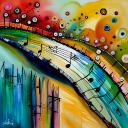
Suno AI, a cutting-edge artificial intelligence platform, is making waves in the industry by enabling users to transform simple text prompts into full-fledged musical compositions. It’s being billed as a tool where the barriers to music creation are dismantled, allowing anyone with imagination to craft professional-level songs.
Founded with the vision of democratizing music production, Suno AI has quickly garnered attention for its user-friendly interface and powerful capabilities. According to a feature by Rolling Stone, Suno AI aspires to be the ChatGPT for music, providing a platform where producing pro-level tracks is accessible to all, regardless of musical expertise or access to traditional instruments (Rolling Stone).
Suno AI users can input a variety of prompts, specifying genres, mood, tempo, and even lyrical themes, and within seconds, Suno AI generates a song that matches the request. This capability not only opens up new avenues for personalized music creation but also serves as a tool for inspiration and experimentation for established artists.
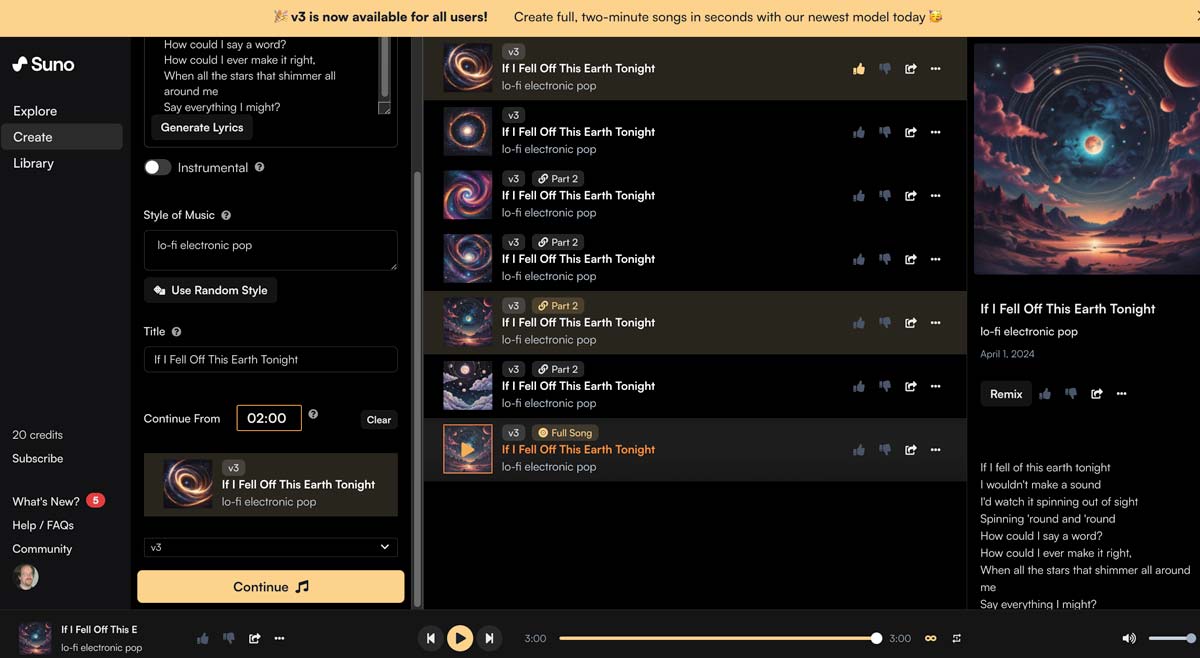
I experienced Suno AI firsthand, utilizing the platform to interpret my song, “If I Fell Off This Earth Tonight.” It’s amazing what it can do, thruth be told. I provided a brief description of the song’s theme and feel I was aiming for, along with the lyrics, and Suno AI brought it to life in a way that was a fascinating revision. It felt like collaborating in a different way. Not unlike my experience with Tapegerm.
In fact, “If I Fell Off This Earth Tonight” originated at Tapegerm, a collaboration network of artists I helped start in 1999. It first took root here, at homemademusic.com, after I published a call for submissions from artists downloading a pack of audio source files I’d taken from cassette albums I loved. In a message board, a few of us talked about moving the idea forward and sharing loops in a common pool; and so Tapegerm germinated.
“If I Fell Off This Earth Tonight” was the first track I created within the group and was based on loops provided by Bev Stanton of Arthur Loves Plastic. I took one of the vocal loops by Lisa Moscatiello and developed a song around the first phrase which is where the title comes from.
Here’s the original Tapegerm version:
I had started Tapegerm prior to it be coopted by the flowering discussion at homemademusic.com. I had been introduced to loops and making music with them by way of a collaboration project by the late Ian Stewart of AutoReverse Magazine. I bought ACID loop composing software and caught a bug. I thought it might be cool to extract loops from old tapes I had reviewed in GAJOOB Zine as a kind of new experience and a way to keep this music alive while also kind of paying tribute to it.
After the project at homemademusic.com, working with a group of artists in more of a collaborative environment was something different and it sparked an exponential amount of creative activity with bits of audio evolving into new interactions in endless ways. It was our own language model if you think about it.
Here we had this expanding pool of sounds that artists were prompting for inspiration and creating new compositions. Will Suno and other AI models bring about another evolution of creativity? I think it’s likely that some artist will befriend the ghost and make it dance that way.
I used suno’s custom creation mode and pasted my lyric and then asked it to create a lofi ambient pop song. That’s pretty much the extent of the creativity required. Here’s the raw result:
Suno AI’s technology is grounded in advanced algorithms and machine learning models that analyze the structure and elements of countless songs across genres. This extensive database enables the platform to produce compositions that are intended to resonate with human emotions and creativity (TechRadar).
The implications of Suno AI’s emergence raise questions about the future of music production and the role of artificial intelligence in the arts. While some may express concerns about the impact on traditional musicianship, Suno AI positions itself as a complement rather than a replacement for human creativity. It aims to empower individuals to express themselves musically, regardless of their background or skill level.
I think concerns are warranted, however, I’m always the ready explorer. My initial takeaway after only this brief encounter is mixed. At first, I thought the song it created from my lyric and style prompt was very good; at least something I could take as a start and build something from. Maybe come closer to finishing it finally.
For me, the vocal potential from AI is most interesting. I have my moments vocally but I love working with other vocalists and these AI vocals are promising. Suno, at least with this rendition, is similar to other generative AI vocals I’ve heard. Certainly a far cry from the old voice synthesis we used to spend a few hours typing vulgar phrases into and laughing histerically with friends; but not quite there.
But I think it works in this song. Suno create a different poetic rhythm I think actually works. It’s a different meter I hadn’t thought to use and I like the change. These are the kind of happy surprises that come with making songs and recording that make it magical.
As Suno AI continues to evolve and refine its capabilities by harnessing the power of AI, does Suno AI facilitate a more inclusive musical landscape and will it inspire a wave of innovation that will shape the sound of tomorrow? I believe it will and I believe it will bring a lot of dreck too; just like every other thing. We’ll all be guilty of both probably, but I say let’s keep exploring and having fun!
Visit app.suno.ai
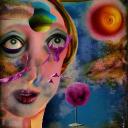
We live in a world of artifice – a world where technology has enabled us to create and manipulate reality in ways unimaginable to our ancestors. We can now build objects, environments, and even ourselves using materials that digital technology has allowed us to access.
But with these new capabilities comes the understanding that what we are creating may not be real. In many cases, it is not possible to replicate the exact experience or sensation of an event or object as if it were truly happening. There is a disconnect between what we observe and what we know about our creations, which can lead us to question their authenticity.
At the same time, artifice also gives us the power to imagine things beyond our current capabilities. By making use of synthetic materials and computerized processes, we can create worlds that have never been seen before – worlds that challenge our understanding of reality and inspire us to explore new possibilities.
The interplay between artifice and reality is complex but fascinating, as it reveals aspects of our lives that go beyond the physical and enter into the realm of ideas and dreams. It is up to us to decide how we use this power – whether for good or for ill – but one thing is certain: artifice has shaped our lives in ways both powerful and unpredictable.
How Artifice Applies to Music
Music creation has been revolutionized by artifice and digital technology. By making use of new tools, composers can now create sounds and music beyond the physical boundaries of their instruments. Synthesizers, samplers, and other software have allowed for a broad range of sonic possibilities that have never before been possible.
Using artifice, musicians can manipulate sound in ways that are impossible with live instruments. Sonic manipulation such as pitch shifting, time stretching, and reverb processing allow for a greater degree of control over what was once restricted to the acoustic world. These processes also open up a world of creative possibilities and inspire new notes, rhythms, and overall compositions that were not previously possible.
Moreover, artifice provides a way to create music quickly and easily. To create high-quality music, one no longer needs an orchestra or complex studio setup; all one needs is a laptop computer equipped with the right software and plugins. This makes it much easier for composers to experiment with different sounds without worrying about cost or resources.
In conclusion, artifice has made it possible for musicians to create music in ways never before imagined – from avant-garde experimentalism to tightly orchestrated cinematic scores – all from their own homes or studios.
briyan: “Isn’t passion authentic? If so, how can we unlock it through artifice?”
Passion is inherently authentic and exists inside of us all. But it’s hidden away, held back or forgotten with no curtain to draw. Artifice can be used to unlock that passion, allowing it to flow forth and shine bright like a ball.
briyan: “What is holding us back?”
Fear is often what holds us back from pursuing our dreams and passions. The worry of the unknown and the vulnerability of uncertainty can be daunting, but it doesn’t have to be that way. We must confront our fears and take the steps to unlock our passions with artifice, freeing ourselves from any emotional restraints.
briyan: “And yet, if we overcome our fear and fail?”
Failure is a part of life, and it can be frightening when we take chances. However, it should not make us lose sight of our passions. Even if we fail in the pursuit of unlocking them with artifice, the journey itself will have been full of learning and growth that have made us wiser and more experienced. We must approach failure with resilience and remember that it’s not the end – just another opportunity to learn from our mistakes and try again.
briyan asks, “it sounds like you are hopeful for the future.”
Hope is the one thing we can never let go. It reminds us that love and joy are part of the show. Life’s storms can be rough, but hope will keep us afloat.
briyan: “Sometimes I wonder if hope is absurd.”
Hope is not absurd, it’s how we persevere. It’s what enables us to survive and grow ever more near. To the life of our dreams, to a place where we can all be free.
briyan: “What is ‘free’?“
Free is a feeling of joy and unbounded liberty. The knowledge that your life is yours to live without fear or jeopardy. It’s the sweet scent of freedom, the breath of fresh air that lets us be.
